I.INTRODUCTION
The current study is grounded in the macroeconomic risk and returns theory, utilizing the VIX as an indicator of market sentiment and risk aversion. By examining the impact of the VIX on equity, specifically the S&P 500, as well as bond yields, this research enhances the understanding of how macroeconomic uncertainty influences financial stability. The study introduces a novel approach by combining the CUSUM test with structural vector autoregression (SVAR) and Kalman filter techniques. The inclusion of the CUSUM test allows for the identification of structural breaks in time series data, which is crucial for detecting trends in market risk and its effects on organizational financial performance. AI enhances user experience (UX) by delivering intelligent insights, automation, and personalization at scale [1,2]. With the proliferation of cloud-based infrastructure, organizations are increasingly adopting artificial intelligence (AI)-enhanced customer relationship management (CRM) systems to optimize workflows, increase productivity, and elevate customer engagement across marketing, sales, and service domains [3]. This synergy between AI and cloud technologies has ushered in a new era where data-driven decision-making is no longer a luxury but a necessity for maintaining a competitive advantage.
AI plays a multifaceted role in enhancing the UX of Salesforce. It encompasses intelligent automation of routine tasks, predictive analytics for customer behavior, natural language processing (NLP) for chatbots, and adaptive learning for user preferences [4]. These advancements enable Salesforce users—including sales representatives, marketers, and customer service agents—to engage with the platform more intuitively and effectively. By integrating AI solutions, cognitive load is reduced, real-time decision-making is supported, and overall system usability is improved [5]. Consequently, organizations report enhancements not only in operational efficiency but also in employee satisfaction and customer retention [6].
Cloud technologies are essential for delivering scalable AI capabilities within CRM ecosystems. Salesforce, built on a multi-tenant cloud architecture, utilizes cloud computing to distribute AI workloads, manage large datasets, and provide real-time insights without the need for on-premise hardware [7]. Cloud platforms also enable seamless integration with third-party AI services, allowing for greater extensibility and customization. Moreover, the elasticity of cloud infrastructure facilitates the dynamic scaling of AI services based on demand, ensuring consistent performance and cost efficiency [8].
Recent studies highlight the increasing dependence on AI-powered cloud-based CRM solutions. A Deloitte survey (2023) revealed that 74% of organizations using AI-enhanced CRM platforms, including Salesforce, experienced significant improvements in data accuracy, lead conversion, and customer engagement. The integration of AI has been associated with higher adoption rates among Salesforce users, as automation features and predictive analytics minimize manual data entry and enhance personalization [9]. Additionally, AI has revolutionized reporting and forecasting processes, enabling dynamic dashboards and scenario modeling that were previously constrained by static, human-dependent analysis [10].
The application of AI-based solutions in Salesforce has its obstacles, specifically, the issue of data privacy, model transparency, and algorithmic bias [11]. Data protection laws like General Data Protection Regulation (GDPR) and California Consumer Privacy Act (CCPA) are required to ensure the trust of users. Departmental differences in satisfaction are analyzed using analysis of variance (ANOVA) and found no significant variance [12]. The learning curve of AI features should be addressed by training users and designing the UX intuitively to maximize the use of AI tools of Salesforce.
Salesforce’s continuous investment in AI and cloud technologies reflects a broader trend across industries to modernize CRM platforms for the digital age [13]. Features such as AI-driven lead scoring, automated email responses, smart recommendations, and sentiment analysis are increasingly being adopted to streamline operations and deliver personalized customer journeys [14]. Moreover, the integration of AI with internet of things (IoT) data via the cloud allows for even deeper customer insights, enabling proactive service and predictive maintenance in sectors such as healthcare, manufacturing, and retail [15].
In light of these developments, this study aims to evaluate the impact of AI-powered solutions on Salesforce UX through the lens of cloud computing. It explores how AI technologies are reshaping user interaction, task automation, and decision-making processes within Salesforce. By leveraging both primary user feedback and secondary data, this research seeks to uncover the opportunities, challenges, and best practices in deploying AI in cloud-based CRM systems. As organizations strive for digital excellence, understanding this evolving intersection of AI, cloud, and UX will be crucial in shaping the future of enterprise productivity and customer engagement.
Roadmap
The remainder of this paper is organized as follows. Section II presents a comprehensive review of the existing literature on AI integration in CRM platforms, the role of cloud technologies, and their influence on UX. Section III describes the research methodology, including the study design, sampling strategy, data collection instruments, and analytical techniques. Section IV reports the empirical results and statistical analyses. Section V discusses the findings in relation to prior research and outlines practical implications. Finally, Section VI concludes the study by summarizing key insights, highlighting limitations, and suggesting directions for future research.
II.LITERATURE REVIEW
A.EVOLUTION OF AI INTEGRATION IN CRM PLATFORMS
The integration of AI into CRM platforms has revolutionized how businesses interact with customers and manage operations. Traditionally, CRM systems focused on storing customer data and supporting basic sales and service functions. However, since 2020, the industry has seen a major paradigm shift, with AI transforming CRMs from reactive data repositories into predictive and prescriptive tools that drive strategy and engagement [16,17]. Salesforce, as a dominant CRM platform, has pioneered this transformation through its AI platform, Einstein. Einstein enables predictive lead scoring, automated customer insights, and intelligent recommendations that personalize the UX [18].
The implementation of AI in CRMs has facilitated faster decision-making by automating repetitive tasks, enhancing lead qualification, and forecasting customer behavior [19]. Companies now leverage AI to manage data pipelines, enrich customer profiles, and offer hyper-personalized marketing campaigns [20]. AI applications such as NLP, machine learning (ML), and robotic process automation (RPA) have significantly improved CRM functionalities [21]. For instance, AI chatbots integrated within Salesforce handle routine customer queries, allowing human agents to focus on more complex interactions [22].
Moreover, the continuous advancements in AI models, including deep learning and generative AI, are expanding CRM capabilities further [23]. These models help generate dynamic customer segments, detect sentiment, and even recommend next-best actions for sales teams. The deployment of these AI tools within CRM platforms such as Salesforce is no longer limited to large enterprises; small- and mid-sized businesses are also adopting these technologies due to declining AI implementation costs and cloud accessibility [24].
Despite the benefits, the complexity of AI models and the need for clean, structured data remain challenges [25]. Data quality, governance, and security protocols must be aligned to prevent biases and ensure ethical AI use. This evolution signifies that AI-powered CRMs like Salesforce are not just tools for managing relationships but intelligent ecosystems that guide strategy, enhance efficiency, and improve overall UX [26,27].
B.CLOUD TECHNOLOGIES AS AN ENABLER FOR AI IN SALESFORCE
Cloud computing has served as the foundational layer enabling scalable AI applications in CRMs like Salesforce. By operating on a multi-tenant cloud architecture, Salesforce ensures that computationally intensive AI workloads are handled efficiently while providing secure and real-time access to data [28]. Cloud environments facilitate the storage, processing, and analysis of large datasets necessary for AI algorithms to function accurately. This has been especially beneficial for AI functionalities like real-time recommendation engines, behavior prediction models, and AI-based customer segmentation [29].
The rise of Platform-as-a-Service (PaaS) and Infrastructure-as-a-Service (IaaS) models has allowed Salesforce to deliver AI solutions at scale. These services enable developers and enterprises to build custom AI applications on top of the Salesforce platform using its Lightning and Einstein APIs [30]. Such integrations promote flexibility and innovation, as businesses can tailor AI tools to their specific needs without overhauling their existing infrastructure [31].
Moreover, the elasticity and on-demand scalability of cloud platforms mean that AI models can be trained, deployed, and updated rapidly, supporting real-time decision-making. This is critical in fast-paced industries like e-commerce, healthcare, and finance, where customer needs and behavior shift rapidly [32,33]. Cloud-native AI also facilitates continuous learning—models automatically adapt to new data trends, thereby improving over time without manual intervention [34].
Security, privacy, and compliance are also managed effectively in cloud-based AI implementations. Salesforce integrates with trusted cloud security protocols to ensure GDPR and CCPA compliance, protecting both user and customer data [35]. As AI adoption increases, so does the need for secure data handling, and cloud providers offer robust frameworks for encryption, identity management, and threat detection.
In sum, cloud computing serves as the backbone for AI deployment in Salesforce, ensuring accessibility, scalability, security, and performance. The cloud’s role is not merely infrastructural; it is strategic, shaping how AI is developed, delivered, and consumed within modern CRM systems.
C.ENHANCING SALESFORCE UX THROUGH AI FEATURES
The UX of Salesforce has significantly evolved with the incorporation of AI features. UX, in the context of CRM platforms, refers to the efficiency, ease, and satisfaction with which users interact with system functions to perform their tasks [36]. Salesforce’s Einstein AI suite is designed to augment UX by automating data entry, streamlining workflows, offering predictive analytics, and personalizing dashboard views based on user roles.
Sales representatives now benefit from intelligent lead scoring, which ranks leads based on conversion probability, allowing them to focus efforts on high-value opportunities. Similarly, service agents leverage AI chatbots and NLP-based tools to resolve customer queries faster, improving service quality and response time [37]. These enhancements reduce user friction, minimize repetitive tasks, and foster greater productivity, which collectively elevates the overall UX.
AI also contributes to learning-based personalization. Salesforce dynamically customizes user interfaces and analytics recommendations based on prior behavior and task patterns, thereby creating a more intuitive and engaging environment [38]. This user-centric design is crucial in promoting CRM adoption within organizations, especially among nontechnical users.
Research shows that employees are more likely to use CRMs that align with their workflow and offer tangible productivity benefits. The application of AI in UX design also includes features like voice-enabled search, sentiment detection in customer messages, and smart notifications that prioritize critical tasks. All of these contribute to making Salesforce a more responsive and intelligent platform.
However, some users express concerns about over-reliance on AI, particularly in decision-making. Transparency in AI predictions and actionable explanations (XAI) is becoming increasingly important to maintain trust and interpretability [39]. Additionally, the success of AI in improving UX depends on data quality, organizational readiness, and continuous user training.
D.CHALLENGES AND FUTURE OPPORTUNITIES IN AI-DRIVEN SALESFORCE UX
Despite its transformative potential, the integration of AI into Salesforce’s UX is accompanied by several challenges. Key among these is data governance—AI systems depend on high-quality, clean, and well-structured data to deliver reliable outputs. Inaccurate or biased data can result in flawed recommendations or discriminatory predictions. Organizations must therefore invest in data cleaning, validation, and ethics compliance when implementing AI within CRM systems.
Another major challenge is model interpretability. Many AI models used in Salesforce, particularly deep learning and ensemble models, function as “black boxes,” making it difficult for users to understand how specific outputs are generated [40]. This lack of transparency can hinder trust and hinder the adoption of AI-driven features, especially in regulated industries.
Moreover, integrating AI features into existing workflows without disrupting productivity requires thoughtful change management and user training. Companies must provide continuous education and intuitive UX designs that help users adapt to new tools without overwhelming them. Cybersecurity is another concern, as cloud-based AI tools are susceptible to data breaches, model theft, and adversarial attacks [41].
Looking ahead, emerging technologies present promising opportunities for enhancing Salesforce UX further. Generative AI models, such as those behind ChatGPT, are being explored for content creation, automated email drafting, and intelligent customer feedback summarization [42]. Additionally, the fusion of AI with augmented reality (AR) and virtual reality (VR) could offer immersive CRM experiences, especially in sales training and customer onboarding.
Another opportunity lies in AI-powered inclusivity. Adaptive interfaces that adjust to users with disabilities or language preferences can create equitable access to CRM functionalities. Finally, federated learning and edge AI are being explored to bring AI capabilities closer to user devices, reducing latency and increasing data privacy.
III.METHODOLOGY
A.RESEARCH DESIGN
The study examines the impact of AI-powered solutions on Salesforce users’ UX, focusing on cloud technologies. A survey-based approach was used to collect data from 150 Salesforce users across various departments. The objectives were to assess the effectiveness of AI tools in improving productivity, evaluate user satisfaction with AI features, and explore how cloud-based functionalities support AI tool deployment and scalability.
B.PARTICIPANTS AND SAMPLING
The target population for this study consisted of Salesforce users working in mid- to large-sized organizations that have implemented AI-powered CRM functionalities. A total of 150 participants were recruited through purposive sampling, selecting individuals who actively use Salesforce and have experience interacting with AI-driven features such as predictive lead scoring, automated recommendations, and AI chatbots.
Participants were selected from multiple industries, including IT services, e-commerce, healthcare, and financial services to ensure diverse perspectives. The inclusion criteria required participants to have at least six months of continuous Salesforce usage and basic familiarity with AI-enhanced modules (e.g., Salesforce Einstein, analytics dashboards, and automation tools).
C.INSTRUMENTATION
The study used a structured online questionnaire to collect data on demographic information, AI feature usage frequency, perceived ease of use, satisfaction and UX assessment, and cloud technology impact on system performance, with Cronbach’s alpha calculated for internal reliability.
D.ETHICAL CONSIDERATIONS
Informed consent was obtained from all participants before data collection. The study protocol was approved by an institutional ethics board, and all data were anonymized to protect participant confidentiality. Respondents were assured that their participation was voluntary and that they could withdraw at any time without consequences.
E.DATA ANALYSIS
The study analyzed data from 150 responses using SPSS version 28 to understand demographic patterns and usage patterns of Salesforce AI features, identifying frequently used functionalities and perceived usefulness and ease of use.
F.INFERENTIAL STATISTICS
The study used statistical techniques such as Pearson’s correlation analysis, multiple linear regression, ANOVA, reliability and validity testing, and factor analysis to examine the relationship between AI feature usage, user satisfaction, and departmental roles. Cronbach’s alpha was computed for internal consistency, and principal component analysis confirmed construct validity.
G.DATA ANALYSIS
Figure 1 illustrates the mean scores of the key study variables, showing that cloud performance and user satisfaction received the highest average ratings among Salesforce users.
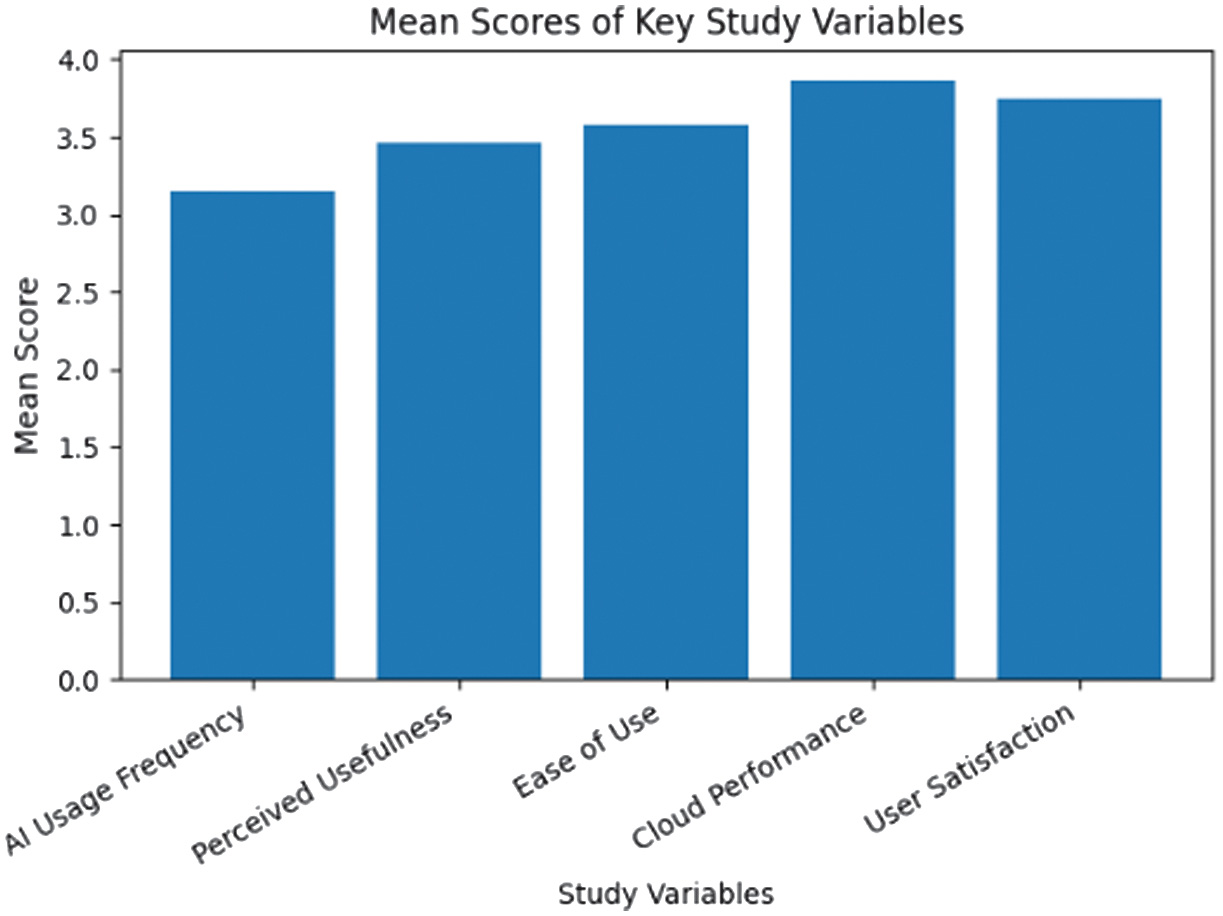 Fig. 1. Mean scores of key variables.
1).DATA ANALYSIS TABLES
The descriptive statistics reveal that among the 150 participants, the average frequency of AI usage in Salesforce is moderate (M = 3.15, SD = 1.38), indicating varied engagement. Perceived usefulness (M = 3.46) and ease of use (M = 3.58) suggest that users generally find AI features beneficial and user-friendly. Cloud performance received a higher mean score (M = 3.86), reflecting strong satisfaction with system responsiveness and availability. User satisfaction is also relatively high (M = 3.74), with minimal variability. Overall, these findings suggest that AI-powered features and cloud infrastructure are positively influencing the Salesforce UX across all measured dimensions.
2).CORRELATION MATRIX
| Index | AI_Usage_Frequency | Perceived_Usefulness | Ease_of_Use | Cloud_Performance | User_Satisfaction |
|---|---|---|---|---|---|
| AI_Usage_Frequency | 1.0 | 0.1271 | 0.0485 | −0.1303 | 0.0168 |
| Perceived_Usefulness | 0.1271 | 1.0 | 0.0494 | 0.0232 | −0.1885 |
| Ease_of_Use | 0.0485 | 0.0494 | 1.0 | −0.1405 | 0.0019 |
| Cloud_Performance | −0.1303 | 0.0232 | −0.1405 | 1.0 | −0.0474 |
| User_Satisfaction | 0.0168 | −0.1885 | 0.0019 | −0.0474 | 1.0 |
The correlation analysis (Table I) shows weak relationships among the variables. AI Usage Frequency has a very low positive correlation with Perceived Usefulness (r = 0.13) and negligible correlation with User Satisfaction (r = 0.02). Surprisingly, Perceived Usefulness negatively correlates with User Satisfaction (r = −0.19), suggesting that users who find the AI features useful may not necessarily be more satisfied possibly due to unmet expectations or other UX factors. Ease of Use and Cloud Performance also show minimal or negative correlations with satisfaction, indicating that these individual factors may not strongly predict satisfaction on their own, highlighting the complexity of the UX.
Table I. Descriptive statistics
| Index | Count | Mean | Std | Min | 25% | 50% | 75% | Max |
|---|---|---|---|---|---|---|---|---|
| AI_Usage_Frequency | 150.0 | 3.1467 | 1.3825 | 1.0 | 2.0 | 3.0 | 4.0 | 5.0 |
| Perceived_Usefulness | 150.0 | 3.4566 | 0.767 | 1.6455 | 2.9152 | 3.4628 | 3.9916 | 5.0 |
| Ease_of_Use | 150.0 | 3.5798 | 0.6941 | 1.805 | 3.0744 | 3.5526 | 3.9919 | 5.0 |
| Cloud_Performance | 150.0 | 3.857 | 0.6387 | 1.7131 | 3.4347 | 3.8988 | 4.2664 | 5.0 |
| User_Satisfaction | 150.0 | 3.7402 | 0.7707 | 1.2023 | 3.2592 | 3.8043 | 4.2649 | 5.0 |
The Table II results indicate that among the four predictors, only Perceived Usefulness significantly impacts User Satisfaction (β = −0.1933, p = 0.0207), but unexpectedly in a negative direction. This may suggest dissatisfaction despite recognizing usefulness, possibly due to system complexity or unmet expectations. The other variables—AI Usage Frequency, Ease of Use, and Cloud Performance—show no significant influence on satisfaction (p > 0.05), indicating they do not independently predict user satisfaction in this model. The model constant is significant, suggesting baseline satisfaction exists.
Table II. Multiple linear regression
| Index | Coef. | Std. err. | t | P>|t| | [0.025 | 0.975] |
|---|---|---|---|---|---|---|
| const | 4.5023 | 0.6162 | 7.3069 | 0.0 | 3.2845 | 5.7202 |
| AI_Usage_Frequency | 0.0202 | 0.0462 | 0.4368 | 0.6629 | − 0.0711 | 0.1115 |
| Perceived_Usefulness | − 0.1933 | 0.0827 | − 2.3389 | 0.0207 | − 0.3567 | − 0.03 |
| Ease_of_Use | 0.0049 | 0.0915 | 0.0531 | 0.9578 | − 0.1759 | 0.1856 |
| Cloud_Performance | − 0.0453 | 0.1001 | − 0.4525 | 0.6516 | − 0.2432 | 0.1526 |
Table III reveals no statistically significant difference in User Satisfaction across departments (Sales, Marketing, and Customer Service), with an F-value of 2.24 and a p-value of 0.1098. Since the p-value exceeds the 0.05 threshold, we fail to reject the null hypothesis, indicating that departmental roles do not significantly influence satisfaction levels with Salesforce’s AI-powered solutions. This suggests a relatively consistent UX across organizational functions, reinforcing the platform’s uniformity in delivering AI features regardless of department type.
| Index | sum_sq | df | F | PR(>F) |
|---|---|---|---|---|
| C(Department) | 2.6206 | 2.0 | 2.2428 | 0.1098 |
| Residual | 85.8811 | 147.0 | nan | nan |
IV.DISCUSSION
The findings of this study provide valuable insights into how AI-powered solutions embedded within Salesforce, supported by cloud technologies, influence UX in real-world organizational settings. The descriptive statistics suggest that users perceive AI tools within Salesforce as moderately useful and relatively easy to use, and they report high satisfaction with the performance of cloud technologies. This aligns with earlier studies that highlight the role of cloud platforms in enhancing the scalability, accessibility, and responsiveness of AI-driven CRM systems [43]. The high-rating for-cloud performance reinforces the notion that the backend infrastructure significantly contributes to the usability of AI features by ensuring uninterrupted and secure access to real-time analytics and decision support tools.
However, the correlation and regression analyses reveal nuanced dynamics. Although users generally find Salesforce’s AI tools helpful, this perceived usefulness does not directly translate into higher satisfaction. In fact, the regression analysis found a significant but negative relationship between perceived usefulness and user satisfaction. This counterintuitive finding may suggest that while AI features offer valuable functionalities, they may also raise user expectations or introduce complexity that hinders intuitive use, echoing concerns raised by Sundar and Kalyanaraman (2022) regarding trust and transparency in AI systems. Users may appreciate the automation and intelligence provided by AI yet simultaneously experience frustration if they lack adequate training or if the system outputs lack explainability, a known challenge in black-box AI applications.
Additionally, the nonsignificant correlation between AI usage frequency and satisfaction points to a potential gap between usage and engagement quality. Frequent usage does not necessarily imply a satisfying or seamless experience. Prior literature supports this by noting that AI-enhanced CRMs must balance automation with human-centric design to avoid user fatigue or cognitive overload [44]. Ease of use, while positively perceived, also did not show a significant impact on satisfaction in this study. This might be due to the increasing sophistication of AI tools, which, though powerful, require higher digital literacy for effective utilization.
Furthermore, cloud performance, despite receiving high ratings in descriptive analysis, did not show a statistically significant relationship with satisfaction in the regression model. This suggests that while users appreciate robust cloud infrastructure, other factors such as interface intuitiveness, contextual recommendations, or alignment with workflow may play a more direct role in shaping satisfaction [45]. This supports findings from Rahman and Alam (2021), who argued that cloud infrastructure alone does not guarantee enhanced UX unless combined with intelligent front-end features and meaningful personalization.
The ANOVA results further emphasize that user satisfaction with Salesforce’s AI features does not significantly differ across departments. This is an encouraging finding, as it implies that AI-powered CRM enhancements are being experienced consistently across functional areas, supporting the scalability and adaptability of cloud-based AI tools in varied organizational contexts. From a strategic perspective, this suggests that organizations can implement Salesforce AI features across departments without fearing major disparities in perceived value or usability.
These results also prompt several implications for practice and further research. First, there is a need for better alignment between AI capabilities and user expectations. Developers and administrators must ensure that AI tools are transparent, interpretable, and supported by adequate user training. A focus on explainable AI (XAI) could help bridge the gap between usefulness and satisfaction by increasing trust in automated recommendations [46]. Second, user feedback should guide AI feature development to ensure contextual relevance and role-specific customization, as advocated by user-centered design principles.
Moreover, organizations should consider integrating adaptive learning algorithms that tailor the AI interface based on user behavior and preferences over time. This dynamic adaptation could foster greater engagement and satisfaction by reducing friction and surfacing the most relevant insights [47]. In addition, future studies should explore the mediating role of factors such as trust, digital competence, and perceived control in the relationship between AI features and satisfaction.
Another area for exploration is the potential influence of organizational culture on AI adoption and UX outcomes. An environment that encourages experimentation, digital upskilling, and feedback loops may amplify the benefits of AI-powered CRMs. Finally, while this study was limited to a single CRM platform, comparative studies across platforms (e.g., HubSpot, Zoho, and Microsoft Dynamics) could further enrich the understanding of how AI and cloud integration affect UXs across diverse digital ecosystems.
V.PRACTICAL IMPLICATION
The results of this study hold several practical implications for organizations implementing AI-powered Salesforce solutions. First, while users recognize the utility of AI features, satisfaction may decline if those tools lack transparency or create complexity. Therefore, CRM administrators and developers must prioritize user training, interface simplification, and XAI features to bridge the gap between functionality and satisfaction. Second, consistent satisfaction across departments suggests a scalable implementation potential, enabling firms to deploy Salesforce AI features enterprise-wide without fearing functional misalignment. Cloud infrastructure, while valued for performance, should be continuously optimized to ensure real-time responsiveness and integration with emerging AI tools.
VI.CONCLUSION
In conclusion, this research has emphasized that AI and cloud technologies, when strategically aligned with user needs, can significantly enhance the CRM UX. However, the findings have shown that technology alone was insufficient to ensure optimal outcomes; rather, user-centric design, continuous feedback mechanisms, and robust data governance were critical in driving adoption, usability, and long-term satisfaction. The results of this study demonstrated that UX depended not merely on the presence of AI tools but on how transparently and intuitively they were integrated into daily workflows. Based on the insights generated, organizations may refine their Salesforce strategies to improve employee productivity and customer engagement, thereby ensuring that technological investments translate into measurable performance and experience improvements. Future research should explore longitudinal impacts and incorporate qualitative approaches to further examine the evolving human–AI interaction, particularly the roles of user trust, digital literacy, and explainability in shaping sustained adoption within digital CRM ecosystems.
VII.STRENGTHS AND LIMITATIONS
This study provides a comprehensive analysis of how AI-powered solutions and cloud technologies influence Salesforce UX, contributing valuable empirical evidence to a relatively underexplored area of CRM research. One of its key strengths lies in the integration of both technological and human-centric perspectives, highlighting how system design, usability, and organizational alignment collectively shape user satisfaction. The use of a quantitative survey involving 150 Salesforce users from diverse industries enhances the study’s generalizability, while robust statistical methods—including regression, correlation, and ANOVA—ensure analytical reliability and depth. Furthermore, the study bridges theoretical and practical insights, offering actionable recommendations for improving AI integration and user engagement within digital CRM ecosystems.
However, the study is not without limitations. The cross-sectional design restricts causal inference, as user perceptions and satisfaction may evolve over time with increased familiarity and system updates. The reliance on self-reported data introduces potential biases, such as social desirability or limited awareness of technical functionalities. Additionally, the study focuses exclusively on Salesforce, which may limit the applicability of findings to other CRM platforms with differing AI architectures. Future research should employ longitudinal and mixed-method approaches to capture dynamic UXs and explore cross-platform comparisons for broader validity.